

Colorful sticky notes are cute, but let’s be honest — they aren’t the most effective way to manage personal or business data.
Luckily, the digital workspace concept and the many platforms that have developed around it make it easier than ever to manage data and share it among users and across devices. These platforms offer much more than note-taking. Market leaders like Notion are robust, multifaceted team collaboration tools.
Unlike some of its well-known competitors, Notion isn’t simply a deck of folders with notes — it’s an all-in-one workspace solution. Notion allows users to create tables, which are basically advanced databases with the look and feel of a spreadsheet. This is a powerful feature — the spreadsheet-database hybrid model has seen increasing popularity in recent years.
Notion isn’t limited to tables, however. Users can take, store, and view notes and other information in various formats, including boards, lists, and galleries. These formats, called “views,” help to organize information quickly. Users can customize the settings for each view, including filters, tags, and sorting, eliminating bulky menus and data overload.
All of that said, there’s no question that Notion is a powerful tool for boosting workplace efficiency, but it isn’t the only solution for collaboration available. Learn more about these 10 task management alternatives to Notion below.
| Tool | Best for | Key features | Pricing | G2 rating |
|---|---|---|---|---|
 Jotform Boards |
Form-based workflows |
|
|
4.7 |
 Evernote |
Note-taking |
|
|
4.4 |
 Coda |
Structured knowledge |
|
|
4.7 |
 Quip |
Salesforce users |
|
|
4.2 |
 Slite |
AI features |
|
|
4.6 |
 Asana |
Simple interface |
|
|
4.4 |
 Microsoft Loop |
Microsoft 365 users |
|
|
4.2 |
 ClickUp |
Advanced features |
|
|
4.7 |
 Nuclino |
Lightweight solution |
|
|
4.7 |
 Airtable |
App-building |
|
|
4.6 |
1. Jotform Boards
Jotform Boards is a task management software built to supercharge the way your forms impact your workflows. Notion users may already be familiar with Jotform as one of the best Notion integrations, but Jotform Boards allows you to cut out the middleman for all your project management needs. This user-first solution helps your team streamline their task management process and increase overall efficiency.
Not only does Jotform Boards allow you to create project dashboards from scratch, but it can also automatically generate actionable tasks from connected form submissions. You can connect a single form or use multiple forms to create a centralized, accessible dashboard for your entire project.
The Jotform Boards interface is designed with a Kanban-style workflow in mind, enabling you to drag and drop tasks wherever you need them. You can also quickly filter and organize your tasks using key fields such as due date, description, priority, or other tags.
This task management solution also facilitates collaboration. You can assign boards to team members, share them across your organization, and track changes using the activity log.
Your workspace in Jotform Boards is also fully customizable. You can decide which fields are displayed in card view, personalize which fields appear in your task layouts, and even adjust your board groups to reflect your real-world workflow process. Dashboards can even be personalized to match your visual branding or personal style.
Jotform Boards is also mobile-friendly and integrates with the Jotform suite of products, providing a seamless project management experience.
- Best for: Form-based workflows
- Developer: Jotform
- Key features:
- Form-based dashboards
- Integration library
- Customization tools
- Pros:
- Automation features
- Integration with Jotform suite
- User-friendly interface
- Cons:
- Newer to the market
- Less robust than other options
- No wikis
- No dedicated note-taking capabilities
- Plans/pricing:
- A free version is available
- Paid plans range from $34 to $99 per month
- Custom pricing is available with enterprise plans
- G2 rating: 4.7
2. Evernote
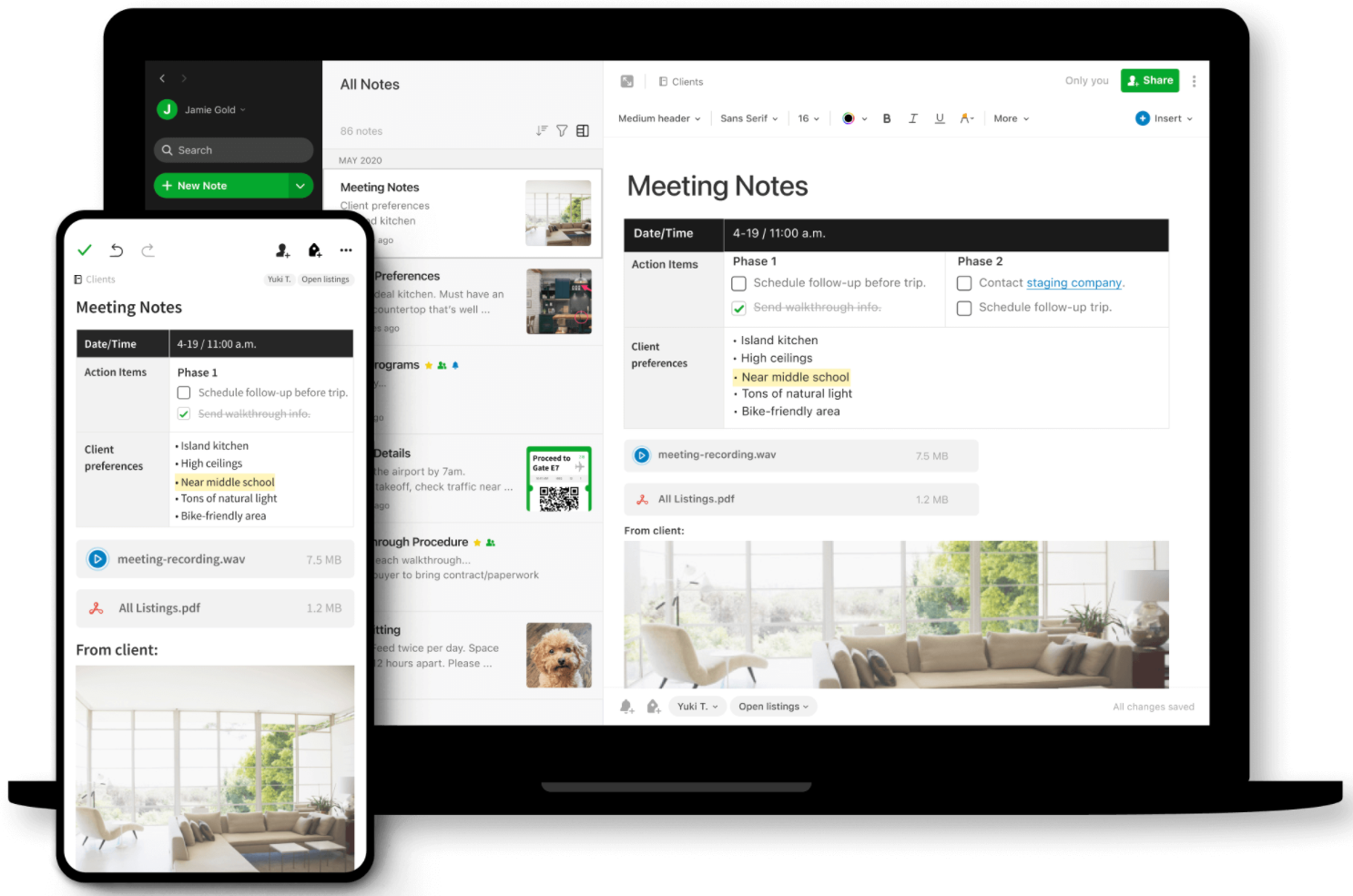
Evernote was the trailblazer — the first company to create a cross-device note-taking solution that gained widespread popularity. Founded in 2004, Evernote boasted that it could help users “remember everything.” It has undergone several transformations over the years, but the current version allows users to take notes in several formats, including text, sketches, PDFs, photos, videos, and even web clippings to capture any thought on the go.
Unlike Notion, Evernote doesn’t try to be an all-in-one workspace tool or offer database tools. Instead, Evernote focuses on helping users organize their thoughts and keep their files in one place.
- Best for: Note-taking
- Developer: Evernote
- Key features:
- Note taker
- Centralized docs
- Evernote Teams
- Pros:
- High-quality note-taking software
- Easy to use
- Customizable
- Cons:
- Less robust than other options
- Usage limits
- Poor customer support
- Mainly focused on note-taking
- Plans/pricing:
- A free version is available
- Paid plans range from $10.83 per user per month
- Custom pricing is available with enterprise plans
- G2 rating: 4.4
3. Coda

Coda is a robust workplace collaboration tool that includes most of the advanced workspace features Notion offers, plus a growing collection of templates that make it easy to create projects faster and enhance productivity. It also provides useful automation tools and easy integration with popular apps like Slack, Google Calendar, and GitHub.
Like most powerful platforms, it does have a learning curve, so familiarizing yourself with Coda’s wide variety of options and functions may take some time.
- Best for: Structured knowledge
- Developer: Coda
- Key features:
- Flexible docs system
- Team collaboration hubs
- Coda AI
- Pros:
- Robust feature library
- Helpful structural tools
- Cons:
- Steep learning curve
- Complex interface
- Lack of desktop app
- Lack of intuitiveness makes it difficult to operate
- Plans/pricing:
- A free version is available
- Paid plans range from $10 to $30 per month per user
- Customer pricing is available with enterprise plans
- G2 Rating: 4.7
4. Quip

Quip is Salesforce’s productivity platform. Though it isn’t as robust as some of the other Notion alternatives on this list, it does have a major advantage in collaboration and communication. On Quip, it’s easy to share documents with team members, add comments, send inline replies, check document history, and more.
Quip is great for jotting down ideas and work plans, and it makes it easy to import your address book from well-known services like Gmail, Microsoft Outlook, and iCloud so you can share your thoughts with your colleagues and friends.
Plus, with Quip, notes can be presented in a variety of formats, like documents, spreadsheets, or team chats, all of which can be organized into folders. This solution doesn’t have the advanced database features of other tools, but the upside is that its simplicity makes it easy to learn and use.
- Best for: Salesforce users
- Developer: Salesforce
- Key features:
- Collaborative docs
- In-app chat
- Workflow templates
- Pros:
- Native integration with Salesforce
- Simple interface
- Salesforce security protocols
- Cons:
- Lack of features
- Requires Salesforce
- No free version for teams
- Only useful for current Salesforce users
- Plans/pricing:
- No team-oriented version is available
- Paid plans range from $10 to $100 per user per month
- G2 rating: 4.2
5. Slite
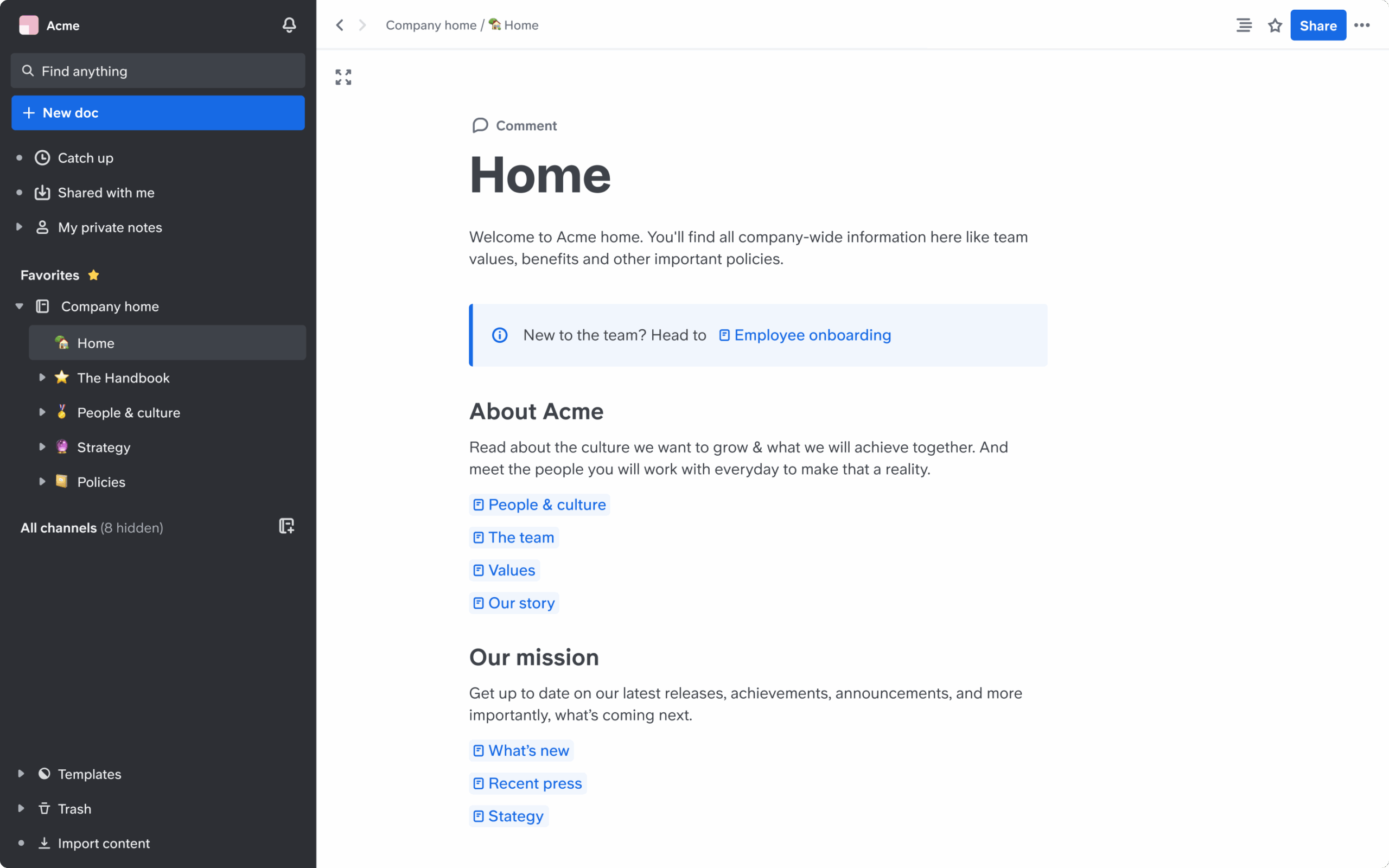
Slite functions a bit like a combination of Notion and the popular workplace communication platform, Slack. The platform’s look and feel is similar to Slack’s, where documents are sorted in channels. Channels can be public or private, and users can store multiple documents in each channel. SIite also offers simpler and more streamlined note-taking tools than Notion.
Its editing tools feel familiar and are easy to use, with the added benefit of AI assistance to accelerate workflows. Documents can be shared, and all parties can work on the document simultaneously in a user-friendly, collaborative system.
- Best for: AI features
- Developer: Slite
- Key features:
- AI-powered knowledge base
- Collaborative channels
- Instant answers
- Pros:
- Advanced AI tools
- Cons:
- Limited features
- No free version
- Limited customization
- Narrowly focused on knowledge management
- Plans/pricing:
- A 14-day free trial is available, but there is no full free version
- Paid plans range from $8 to $12.50 per member per month
- Custom pricing is available with enterprise plans
- G2 rating: 4.6
6. Asana

Asana was created as a workflow management tool rather than a note-taking or database application, although it offers many of those features. It organizes everything from basic tasks to overall business objectives so that every team member can understand their responsibilities and priorities.
Asana offers several ways to visualize workflows, also called “views,” which include lists, Kanban boards, Gantt charts, and calendars. You can also share documents with other users or save them in common project boards.
- Best for: Simple interface
- Developer: Asana
- Key features:
- Project management dashboards
- Goal tracking
- Workload management
- Pros:
- Custom automations
- Goal-oriented management features
- Integration library
- Cons:
- Key features limited to top paid tiers
- Limited file export formats
- Learning curve, no native docs or wiki features
- Plans/pricing:
- A free version is available
- Paid plans range from $11 to $25 per user per month
- Custom pricing is available for Enterprise and Enterprise Plus plans
- G2 rating: 4.4
7. Microsoft Loop
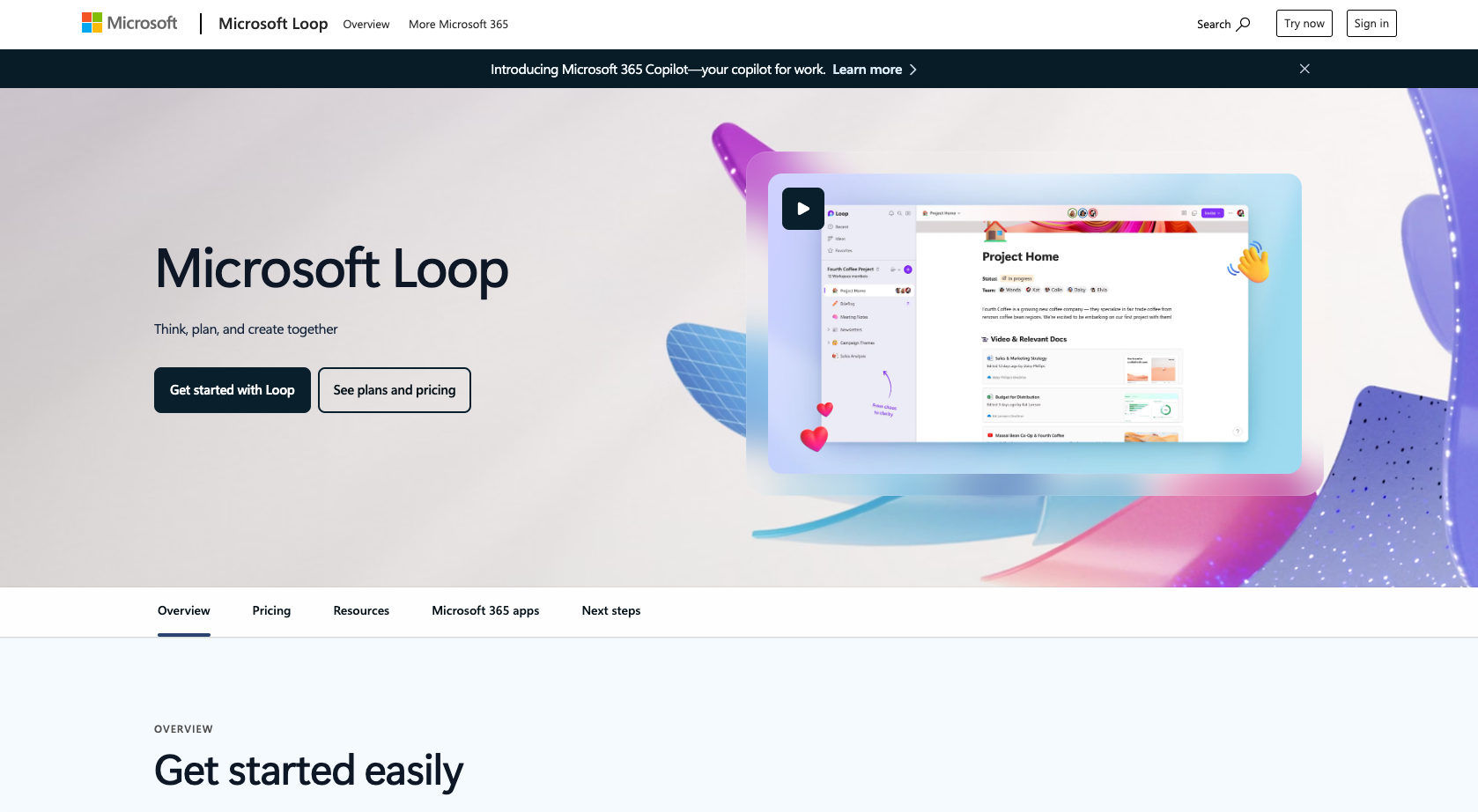
If you already subscribe to Microsoft 365, you will have access to Microsoft’s native workspace collaboration software: Microsoft Loop. This solution allows your team to work on collaborative documents within your Microsoft environment, reducing the need for an additional investment in a third-party collaboration app.
However, compared to other workspace collaboration software, Microsoft Loop lacks advanced features. If you’re satisfied with a more basic solution, this may not be an issue, but it could limit your team’s ability to maximize efficiency. Access to Microsoft Loop is also limited, as it is only available as part of the larger Microsoft 365 suite of products.
- Best for: Microsoft 365 users
- Developer: Microsoft
- Key features:
- Collaborative documents
- Microsoft Copilot integration
- Dynamic content blocks
- Pros:
- Native integration with Microsoft apps
- Easy to use
- Web-based
- Cons:
- No free version
- Dependent on Microsoft suite
- Lack of advanced features
- Requires Microsoft 365 subscription
- Plans/pricing:
- No free version available
- Paid plans for Microsoft 365 range from $6 to $22 per user per month with Teams
- From around $5 to $20 without Teams
- G2 rating: 4.2
8. ClickUp

ClickUp is designed to be an all-in-one tool for your team’s knowledge and project management. This solution offers a depth of features geared toward improving your team’s efficiency, collaboration, and productivity. It also offers one of the best free versions on the market, providing users with many features that other solutions reserve for top-tier paid plans.
However, due to the depth and complexity of this tool, ClickUp has a steep learning curve for less experienced users. This can not only impact your overall experience, but your return on investment as well. This functionality can also cause ClickUp to work more slowly than other, less feature-heavy solutions.
- Best for: Advanced features
- Developer: ClickUp
- Key features:
- Collaborative documents
- Digital whiteboards
- Wikis
- Pros:
- Extensive free version
- Wide range of features
- More than 1,000 integrations
- Cons:
- Learning curve
- Slow loading program
- Limited mobile views
- Complex platform can be slow compared to other alternatives
- Plans/pricing:
- A free version is available
- Paid plans range from $7 to $12 per user per month
- Custom pricing is available with enterprise plans
- G2 rating: 4.7
9. Nuclino

One of the pitfalls many users experience with Notion is that its complexity can make it slow, like ClickUp, and difficult to operate. That’s why Nuclino set out to create a lightweight alternative that provides the essential tools you need without the extra bulk that could slow you down. This solution offers many of the same core features of Notion, such as wikis and collaboration tools, but slims back its interface to be fast and user-friendly.
The other side of the coin for this lightweight design is a lack of advanced features compared to more comprehensive solutions like Notion. While you may be able to work faster and initiate users more quickly, you may also be giving up some of the powerful capabilities other Notion alternatives offer.
- Best for: Lightweight solution
- Developer: Nuclino GmbH
- Key features:
- Unified collaboration space
- Knowledge sharing
- Project management
- Pros:
- Straightforward interface
- User-friendly
- Fast
- Cons:
- Fewer features
- Lack of integrations
- Limited growth potential
- Less robust than other alternatives
- Plans/pricing:
- A free version is available
- Paid plans range from $6 to $10 per user per month
- G2 rating: 4.7
10. Airtable

Airtable is an end-to-end workspace collaboration solution specifically targeted toward app design. This solution helps development teams manage team knowledge, communicate project updates, and maintain an accurate record of relevant data. Information can be organized in tables or multiple customizable visualizations.
Since this solution is so specifically targeted, Airtable may not have some of the general use features you’re looking for. Likewise, it could have a steep learning curve if you’re not part of its intended audience, developers. It’s also worth noting that Airtable is one of the most expensive solutions on this list. However, if you do work in the app development realm, this solution could offer you the best value for your investment.
- Best for: App-building
- Developer: Airtable
- Key features:
- App-building platform
- Automations
- Data visualizations
- Pros:
- Highly automatable
- Customizable data interfaces
- Cons:
- Limited user scope
- Steep learning curve
- Expensive
- Very difficult interface to learn for beginners
- Plans/pricing:
- A free version is available
- Paid plans range from $20 to $45 per seat per month
- Custom pricing is available with enterprise plans
- G2 rating: 4.6
Not your average note-taker
The shift toward remote work has accelerated demand for more advanced note-taking, collaboration, and workspace tools. Besides Notion, there are several options with robust features that make it easy to create, organize, and share information.
What’s more, easy customization allows you to build tools to fit your unique needs. With so many powerful Notion alternatives on the market, the right one for you is just a few clicks away.
This article is for professionals, teams, and organizations looking for flexible, feature-rich tools to manage projects, collaborate, and organize information beyond traditional note-taking.

























Send Comment: